

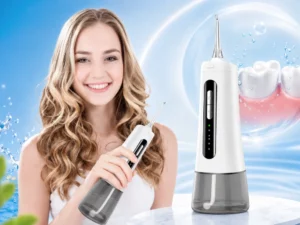
For someone whose teeth react to cold water or whose gums are already tender, the highest-output setting is rarely the deciding factor. The useful device is one whose stream can be aimed, softened, and increased gradually without making daily cleaning something to dread.
Four controls shape that experience: pressure, water temperature, nozzle placement, and stream consistency. A water flosser for sensitive teeth and gums has to make a complete routine possible without sharp pain or irritation that lingers afterward.
Why Sensitivity Changes Water-Flossing Comfort
Sensitive teeth and tender gums can react for different reasons. Cold water or exposed dentin may bother a tooth; sore or swollen gums may react to direct contact. Water flossing introduces a moving jet along the gumline and through the spaces between teeth.
The same setting can therefore feel fine for one person and unpleasant for another. A user with more sensitivity may need lukewarm water, a softer mode, and a slower route around the gumline.
Cold Sensitivity: Set Water Temperature Before Pressure
Even a low-pressure stream can feel uncomfortable when cold tank water reaches a cold-sensitive tooth. Try room-temperature or lukewarm water first, keeping it comfortably warm rather than hot.
Only after the water feels acceptable should you alter pressure. Making one change at a time shows more clearly which factor is responsible for the reaction.
Tender Gums: Stream Direction and Dwell Time
Directing the jet into tender gum tissue from close range, or leaving it on one spot, is more likely to cause a reaction. Let the stream travel along the gumline, pause between teeth, and move away from areas that are already sore.
Settings cannot resolve every source of mouth discomfort. Heavy bleeding, sharp pain, swelling that does not settle, or unusual sensitivity in a single tooth should be assessed by a dental professional.
Selecting a Starting Mode and Pressure
Begin where the stream is easy to control and the intensity is not bothersome. Use that level for a few full sessions. A brief first impression is less useful than noticing how the mouth feels after the complete routine.
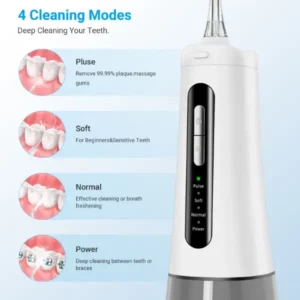
Mode labels matter only when they create meaningful steps in use. Soft, Normal, Pulse, and higher-output options let a sensitive user choose a suitable intensity instead of treating maximum power as the default.
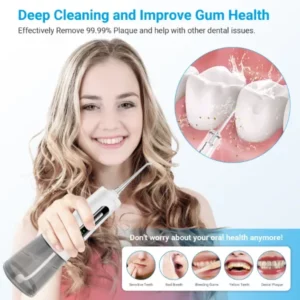
The M209 rechargeable oral irrigator has four modes: Pulse, Soft, Normal, and Power. Its Soft mode is intended for sensitive teeth. The unit also has a 310 ml detachable tank, double IPX7 waterproof construction, smart memory, and 360-degree rotating replaceable nozzles.
Why Maximum PSI Is Not the Daily Decision
PSI tells you how high a device can go, but says little about how manageable the lower settings are. For a sensitive mouth, the usable range between the two ends is the more relevant comparison.
A wider range can be practical in a shared household or for someone who later becomes comfortable at a stronger level. The working setting is the one that allows a thorough pass without rushing, skipping spots, or ending early.
How Nozzle Placement Alters the Sensation
Pressure alone does not determine how the stream feels. A change in where the jet lands can turn that same setting from gentle to harsh.
Position the nozzle inside the mouth before starting the unit, with your face over the sink. Keep the lips partly closed against splashing, then trace the gumline tooth by tooth. The brief pauses belong in the gaps between teeth, not on sore gum tissue.
Set a Shallow, Moving Path
There is no need to press the tip into the gums. Hold it slightly away, then guide the water toward the tooth-gum junction. A rotating nozzle can help around bridges, implants, orthodontic hardware, or crowded teeth because the wrist does not have to follow every angle.
With a 360-degree nozzle, the handle can remain steady while the stream is turned toward inner surfaces and other hard-to-reach areas.
Comfort Matters More Than a “Deep Clean” Sensation
Stinging is not evidence of a better clean. A moderate setting used carefully around the whole mouth is usually more workable for sensitive users than a forceful setting used briefly.
Remembering the last-used mode has a practical benefit: the next session is less likely to open at an intensity that catches the user off guard.
Features With a Direct Comfort Benefit
For a sensitive user, a feature matters when it makes the device easier to control or easier to keep clean:
| Feature | Why it matters |
| Soft or low-pressure mode | Makes it easier to begin at a comfortable intensity |
| Multiple pressure options | Gives room to adjust as comfort changes |
| 360° rotating nozzle | Improves control around the gumline and hard-to-reach areas |
| Detachable water tank | Makes rinsing and cleaning the reservoir easier |
| Useful tank capacity | Reduces interruptions during a full-mouth clean |
| Smart memory | Helps avoid an unexpectedly strong start |
| IPX7 waterproof design | Supports easier cleaning in a wet bathroom environment |
Mlikang’s portable M139 combines a 300 ml detachable tank with Pulse, Soft, Normal, and Power modes. It also includes a 360-degree rotating replaceable nozzle, smart memory, and double IPX7 waterproof construction.
The Mlikang range includes portable, household-oriented, rechargeable, and multi-function water flossers. Tank capacity and the control layout differ across those formats, so they are better compared as use cases than as a single model type.
When a Water Flosser Reveals Existing Sensitivity
Cold water or excessive pressure can make an existing sensitivity stand out during water flossing. The device cannot tell whether that sensitivity is linked to exposed dentin, recession, decay, a crack, recent dental work, or another condition.
Try warmer water when cold is the trigger, and lower the setting when intensity is the trigger. If discomfort remains after those changes, or also appears while eating or drinking, have the tooth evaluated.
A Controlled Two-Session Check
For the next two uses, hold the basic conditions steady so that common triggers are easier to separate:
- Use lukewarm water in the tank.
- Choose the lowest setting that still feels controlled.
- Keep the nozzle moving as you follow the gumline.
- Complete the full routine without dwelling on tender areas.
- Make a note of whether discomfort is local or widespread.
Repeated sharp pain from one tooth, while the rest of the mouth feels normal, is not likely to be explained by continually changing the pressure setting.
Engineering That Supports a Predictable Stream
Good technique depends on a device that delivers water consistently. A low or soft mode cannot offer much comfort when pressure changes unpredictably, a water path leaks, or the nozzle is awkward to direct.
Mlikang develops and manufactures oral-care devices with its own technical department and testing laboratory. Its water-flosser quality-control equipment includes water-pressure testing, tank airtightness testing, waterproof testing, noise testing, leakage testing, static and dynamic leakage detection, electrical testing, and aging racks. The company also applies inspection before shipment.
The manufacturing checks behind that behavior are not obvious to the person holding the device. What reaches the user is a repeatable stream, a housing that copes with a wet bathroom, and a flosser that remains comfortable enough to use often.
For a brand or distributor, those same factors form a product brief: define the pressure behavior, mode logic, nozzle control, tank size, waterproof requirement, and acceptance tests before production. Mlikang supports OEM and ODM work covering design, function, branding, packaging, prototypes, and testing.
If you are evaluating a sensitive-use configuration for your own market, discuss your water flosser requirements with Mlikang and define the comfort-related features before sample approval.
Conclusion: A Practical Fit for Sensitive Teeth and Gums
Sensitive users benefit from a flosser whose Soft setting is truly mild, whose pressure changes are manageable, and whose nozzle can be positioned without strain. A tank that lasts through the routine and a design that rinses easily make the device more practical to keep using.
The better fit is the water flosser that lets you work around the whole mouth without expecting pain. Start with comfortable water and a low setting, keep the stream moving, and increase pressure only after that level becomes familiar. Pain that stays sharp, localized, or persistent needs an explanation beyond the mode selection.
FAQs
Q1: Which water-flosser controls matter for sensitive teeth and gums?
Prioritize a real low-pressure or Soft option, sensible steps between intensity levels, a nozzle that can be directed accurately, and enough tank capacity to finish at a normal pace. Those controls usually matter more to a sensitive user than the headline PSI figure.
Q2: Can a water flosser make tooth sensitivity more noticeable?
It can, especially when cold water or an overly strong stream is involved. If lukewarm water and a lower setting do not improve the situation, or one tooth stays sharply sensitive, the cause may lie elsewhere and should be checked.
Q3: Can sensitive gums tolerate daily water flossing?
Many people can use a water flosser every day at an intensity that feels comfortable. Keep the stream traveling along the gumline instead of concentrating force on tender tissue. Ongoing bleeding, swelling, or pain calls for dental advice rather than further setting changes alone.