

A brand asks for an ultrasonic retainer cleaner sample and often receives the wrong product. The box that arrives may be cleaning tablets. It may be a jewelry tank. It may be a clinic machine built for steel instruments. The names overlap. The unit a customer uses on a retainer at home is none of those.
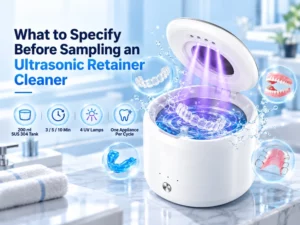
Write the sheet before you approve the sample. An ultrasonic retainer cleaner OEM project starts from that sheet, not from a product name. For this home unit, our U13 sheet is short. The tank is 200 ml of SUS 304. The panel stops at 3, 5 or 10 minutes. Four lamps in the lid run UV after that wash. The logo can wait. The tank, the times, and the UV step cannot.
Which Product You Are Sampling
Tablets, a jewelry tank, or a clinic machine
Many private label retainer cleaner offers are tablets. A tablet dissolves, fizzes, and freshens the surface it can reach. It does not shake a bath. If you want tablets, write that on the brief and send it to a tablet supplier. If you want a machine, ask for a private label retainer cleaner machine and attach this sheet. A tablet quote is a different project, even when the carton says retainer cleaner.
Many private label ultrasonic cleaner offers are jewelry and industrial tanks. Those tanks are sized for metal and stones. The liquid is often a solvent, and someone often leaves the run going. A clear aligner is not a ring. A solvent that is normal on a jewelry counter will craze the plastic a customer wears against the cheek.
Ask for a dental ultrasonic cleaner and the offer is often a clinic machine for steel instruments. That is the wrong bath. A buyer who needs the clinic machine should say so as its own project. We build the home unit for retainers, aligners, mouth guards and dentures.
One appliance in the 200 ml tank
SUS 304 lines the U13 bowl, and the water stays there. A single retainer sits covered in 200 ml. An aligner, a mouth guard, or a denture can take that same place on its own turn. Two trays in that volume leave the lower rim out of the water, and the film starts again on that dry rim. The sample photo we want shows one appliance, covered.
What to Write on the Sample Sheet
Tank, times, and the UV step
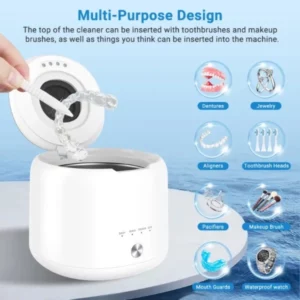
Stand the sample on the bench and copy the panel. Ours reads 3min, 5min, 10min and UV. Press one time and the ultrasonic run ends there. A thin aligner that keeps running through dinner is the tray that comes back warped. The button is what prevents that.
UV comes second. Four lamps sit in the lid and cover the bowl through 360 degrees. We rate that UV pass at three times the cleaning of a toothbrush. The rating covers odor, and film on a surface the bubbles have already cleared. Film still sitting in a scratch shadows the lamps. Write the order on the sheet as wash first, UV second.
The hardware line is 200 ml, SUS 304, then 3, 5 and 10 minutes, then UV. If the approved unit shows a frequency, copy that figure and no other. A kilohertz number from another brand’s page stays on that other brand’s page.
Pour water that is already lukewarm. The U13 bath stays at that temperature. A hot fill is what pushes a clear tray off the canine. The sheet names a lukewarm fill.
Which retainer the customer wears
The time follows the appliance, not the word retainer.
A clear aligner the customer will wear again the same day takes 3 minutes. You are lifting that day’s film from a thin thermoformed tray. A tray that has been shut in a case is a longer job.
A Hawley retainer takes 5 minutes. A Hawley is the removable retainer with a plastic plate and a metal wire across the front teeth. Your customer wears that wire. The U13 is the bath the retainer goes into. Plaque sits in the little hole where the wire enters the plastic. Three minutes often leaves that hole dull. The wire itself is fine in the water.
A retainer that has been sitting, or a tray that is already cloudy, takes 10 minutes. A thin night guard follows the aligner time. A thicker plastic guard follows the Hawley time. A partial denture with a metal clasp is closer to the Hawley: the clasp entry collects plaque the way the wire entry does, and the pink base is what you are keeping away from hot water.
A bonded retainer is a wire glued to the tongue side of the teeth. It stays in the mouth, so it is not a sample item for this tank. Cleaning around that wire belongs on a water flosser brief.
What the Trial Has to Show
Run the appliance your customer wears
A demo with a ring, or a dry run that only proves the tank hums, does not approve a retainer cleaner. Run the trial on the appliances in your line. Use a clear aligner. Use a Hawley if that is who you sell to. Use a night guard or a denture if those are in the range. Write down the water, the fill level, the time, and how the item sat in the tank.
Look at the groove and at the wire entry, not only at the flat face. Then look at the plastic after several cycles. Cloudy patches from toothpaste are scratches. The bath can lift film out of them. The shine does not come back. If the trial uses a hot tap or toothpaste to “show a stain coming off,” you are looking at a damaged sample.
Agree the pass and fail in writing before the trial. Visible film gone from the groove, no warp, no new clouding from the bath itself. A foil test can show that the tank is agitating. It does not prove a retainer is clean.
Claims that can go on the box
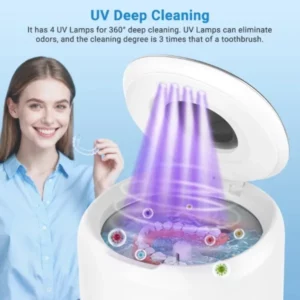
Print what this unit did in the trial. On the U13 carton, that means the 200 ml tank, the three times, four UV lamps through 360 degrees, and the UV rating of three times a toothbrush. That rating is odor and surface film after the wash, which is the trial you just ran.
Sterilizing and disinfecting stay off the carton unless you hold evidence for this exact configuration in the market you sell. A UV lamp on the lid is not that evidence. Ultrasound is not that evidence either. The same rule covers a frequency copied from another listing. If it is not the figure on your approved unit, it does not go on your box.
Turning the Sample into the Order
The U13 as the starting unit
Creativo builds the U13 for retainers, aligners, mouth guards and dentures. The U13 ultrasonic retainer cleaner is the home unit we put forward when the brief is one appliance, a fixed set of times, and UV after the wash.
Say in the first note if you need a different tank, a different set of times, or a bundle with tablets and a case. The current unit is the faster sample. A new tank or a new housing is a wider project, and it needs its own trial. Do not treat that change as a logo swap.
El retainer ultrasonic cleaner category is where this home unit sits. Use it to see the configuration, then send the sheet.
What to send with the brief
Send the destination market, the appliances your customer wears, the times you want on the panel, and whether UV is included. Send the plug and adapter for that market with the sample, not after the order is placed. A changed plug is not the whole adaptation. The adapter, the label, and the manual have to match the same market.
Send artwork after the specification is frozen. A logo on a screen mockup does not lock the product. Check the print on the housing, under normal light, on the actual sample.
Tell us the quantity range you are planning, and whether the first step is a sample of the U13 or a change to the platform. The quote for an OEM retainer cleaner follows that sheet. When the reorder comes, the ultrasonic retainer cleaner wholesale lot matches the approved sample, including the times and the claims. Quote from the sheet. The product name, on its own, might still mean a tablet, a jewelry tank, or a clinic machine.
Conclusión
Lock the sheet before the sample ships. This home unit is a 200 ml SUS 304 tank, a stop at 3, 5 or 10 minutes, and UV after the wash. The aligner worn again tonight is the 3-minute line. The Hawley is the 5-minute line. A tray that has been sitting is the 10-minute line. The carton repeats what the trial showed. Tablets, jewelry tanks, and clinic washers stay on their own briefs.
Preguntas frecuentes
Q1: Can one sample time cover both clear aligners and Hawley retainers?
A1: The tank can be the same unit. The time on the sheet should not be the same number. Put 3 minutes down for a clear aligner worn again the same day, and 5 minutes for a Hawley, where the wire enters the plastic. One shared time is how the wire entry stays dull, or how the thin tray sits in a longer bath than it needs.
Q2: Can we print “sterilizes” because the sample has UV?
A2: On the U13, the UV step is specified for odor and for film on a surface the bubbles have already cleared. Sterilizing is a separate claim. It needs evidence for that exact unit and for the market you sell. A lamp in the lid is not that evidence.
Q3: Do we have to put a frequency on the sample sheet?
A3: Put a frequency on the sheet when that figure is on the approved unit. For the U13, the lines to lock are the 200 ml SUS 304 tank, the 3, 5 and 10 minute stops, and the UV step. A number copied from another brand’s page is not your specification.