

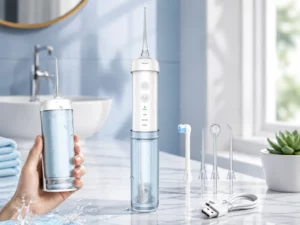
A cordless water flosser has no power cord to keep it next to the outlet. Fill the tank, switch it on, and move the handle as you clean. Countertop models stay beside an outlet and often have a larger tank. They can suit a fixed bathroom, but they take more counter space and are harder to move. Using a water flosser is easier in a small bathroom or while travelling when the device can be picked up, used, rinsed, and stored without rearranging the sink.Before choosing a model, check the tank size, pressure control, nozzle choice, grip, waterproofing, charging, and cleaning.
What Changes When a Water Flosser Is Cordless?
Movement Around the Sink
A countertop water flosser stays next to its tank and power source. The handle can only go as far as the hose allows. A cordless model moves around the sink, which can make the back teeth easier to reach. In a shared bathroom, the handle can move without taking the whole tank with it. This is also useful when the sink is narrow or another person is using the counter.
That is a handling difference, not a promise of better cleaning. Water still has to be directed properly, and pressure and nozzle choice still matter.
Less Setup for a Regular Routine
A fixed unit needs a permanent spot. A cordless one can go into a cabinet, drawer, or travel bag after use. Daily water flosser use fits more easily into a shared bathroom or a short morning routine when the counter does not have to stay prepared.
Fill the tank, choose a mode, use the nozzle, rinse the water-contact parts, and let them dry. The routine still needs care, but it does not need a permanent setup.
Why Portability Matters in Daily Use
Size, Tank, and Storage
A portable water flosser is useful where space is tight: a small bathroom, a shared sink, or a travel bag. A smaller body helps only if the tank is still easy to fill and the nozzle and charging port have somewhere to go. A clear place for spare tips also helps prevent them from being misplaced.
The M141 has a retractable design and a 210 ml water tank. It takes less room in a cabinet or bag. The tank is part of the size trade-off: the body stays compact, but a longer session may need a refill. For travel, the opening should still be easy to fill, rinse, and dry after use.
A smaller tank keeps the body compact. A larger tank means fewer refills but needs more storage space. Neither choice is automatically better; it depends on where the device will live. In a small bathroom, a user may accept one refill in exchange for easier storage.
A Product That Is Easy to Put Away
A portable water flosser also has to be easy to put away. The tank should open or detach without a struggle, and wet hands should not make the handle hard to control. Rinsing and drying need to be quick enough to become part of the same routine.
If the device takes too long to prepare or clean, it becomes harder to use every day.
How Pressure and Nozzles Affect the Experience
Pressure You Can Adjust
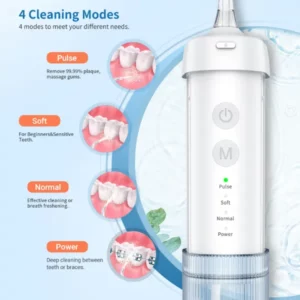
A rechargeable water flosser should offer a comfortable starting point. The M141 has four modes and a 40–120 PSI range. A new user can start lower and adjust the pressure after becoming familiar with the device. In a shared household, different users can choose different settings without changing the whole product.
Clear controls make a rechargeable water flosser easier to live with. In a shared home, each user can return to a familiar setting. Pain, bleeding, or concerns after dental treatment should be discussed with a dental professional, not solved by turning up the pressure.
Nozzles That Fit the Routine
The M141 comes with four replaceable nozzles. Different tips can serve different household needs. Each one should be easy to identify, attach, rinse, and store. After use, the tips can be rinsed separately and kept ready for the next session.
The nozzle also affects access to the back teeth. If changing tips takes too much fiddling, the routine becomes harder than it needs to be. A tip that reaches the right area without repeated adjustment is easier to use at home.
How Mlikang Builds and Tests the Product
Waterproofing and Cleaning
The M141 has an IPX7 waterproof design. It suits use around the sink and routine rinsing. After use, rinse the water-contact parts and let them dry before storage.
Using a water flosser should end with a quick rinse. Empty the tank when needed and let the parts dry.
Features Made for Daily Use
Mlikang has more than ten years of experience making oral-care devices. Its own factory includes four production lines, an independent technical department, and a testing laboratory. For a water flosser, the team can work on the structure, pressure, tank, and waterproofing before production.
The M141 combines a retractable body with a 210 ml tank, four modes, 40–120 PSI, four nozzles, Type-C charging, and IPX7 waterproofing. The user can store the body, fill the tank, adjust the pressure, change the tip, and rinse the unit at home.
Testing Before the Product Reaches You
The testing laboratory checks water pressure, waterproofing, noise, tank airtightness, leakage, and aging. A sample can be filled, run through each pressure mode, fitted with different nozzles, rinsed, and checked for leaks. The tank and nozzle can also be handled with wet hands during a practical review.
During sample review, the team can check tank access, grip, pressure modes, nozzle configuration, and waterproofing before production. It can also check how quickly the parts can be cleaned between sessions.
Mlikang develops products from requirements and structural design through prototypes and sample confirmation. Before production, the team can review tank access, grip, pressure modes, nozzle configuration, and waterproofing. The same review can catch assembly or access problems before a larger production run. OEM/ODM support covers function, appearance, color, logo, nozzle configuration, and packaging through its OEM/ODM service.Every product undergoes 100% inspection before shipment through the quality assurance process.

Conclusion
A cordless water flosser is useful when a cord, fixed socket, small bathroom, or travel routine makes a larger unit awkward. It is not the right format for everyone. For many users, the deciding question is whether it is easy to fill, hold, clean, and store.
The M141 combines a retractable body, 210 ml tank, four modes, 40–120 PSI, four replaceable nozzles, Type-C charging, and IPX7 waterproofing. Readers can compare the portable M141 model with other products in the wider water flosser range.
Mlikang’s factory and testing team support these product details. The Mlikang team can answer product questions; the Mlikang website and contact Mlikang page are also available for custom requests.
Frequently Asked Questions
Q1: What is the main benefit of a cordless model?
A cordless model is easier to move and store. A countertop model can suit a permanent bathroom and a larger tank. Regular water flosser use is easier when the format fits the user’s bathroom and routine.
Q2: What should I check before choosing one?
Check the tank size, pressure controls, nozzle set, grip, waterproofing, charging method, and cleaning steps, especially if the device will be used in a small bathroom or while travelling.
Q3: Is a cordless water flosser suitable for everyone?
A cordless model can suit many routines, but not everyone needs the same setup. Anyone with pain, bleeding, or questions after dental treatment should ask a dental professional. Mlikang’s M141 is one example with a retractable body, four modes, four nozzles, and IPX7 waterproofing.