
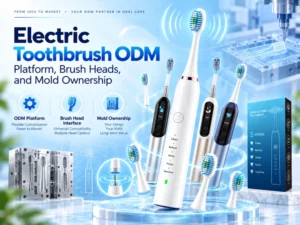
Two quotes are on your desk. Both say 40,000 vibrations a minute, five modes, IPX7, a two-year warranty. One costs far less. Nothing in either document explains the difference.
We build electric toothbrushes, so we’ll tell you where the difference hides: in three things that never reach the quote — the platform, the head interface, the head tooling.
Get those three right before the purchase order. Get them wrong and you’ll pay again at the second SKU.
Why the Handle’s Numbers Cannot Decide Your ODM Choice
The Handle Sells Once, the Head Sells Every Quarter
Your customer buys a handle once and replaces heads for years. How many heads that means depends on the replacement interval you publish and on how many ship in the box, so anyone modelling repeat revenue has to fix both before the first order.
We watch that ratio, because it decides who earns what. The head is your repeat revenue, and it’s the part a factory controls most quietly. Industry benchmarks in this company’s oral care market research put brush-head subscriptions at $6 to $15 per quarter; recurring revenue runs three to five times the annual hardware take.
Take a running platform and you inherit its head geometry, its bristle source (we use DuPont across the range), and its replacement cadence.
Two years later, three questions find you. Do third-party heads fit my handle? Does a second SKU need another mold? Will anyone still supply that head in year three?
Ask your factory both halves of that: how head supply gets secured, and what happens when the platform is retired.
Two Identical Spec Sheets Can Be Two Different Businesses
Read what the spec sheet covers: motor, housing, modes, rating. Useful. Quiet about platform origin, coupling tolerance, and whether the tooling already exists.
That quiet is your price gap. A factory quoting a platform already in production carries no handle tooling and almost no function-definition cost — an earlier customer paid for both. A factory developing to your brief carries tooling, handboards, and a full validation round.
Both quotes are honest. Treat them as one purchase and you’ll spend more than the difference that caught your eye. Ask which platform is being quoted, and who paid for it.
The Four Questions That Set Your Line
Which Platform You Inherit
Three routes reach the same handle shape. ODM hands you a design we already run. OEM follows a specification you bring. Private label puts your name on a unit that ships today.
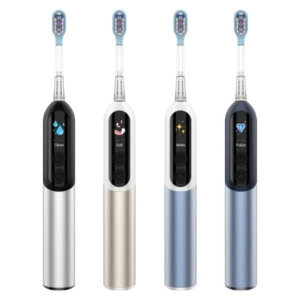
の electric toothbrush product range shows how far one supplier’s platforms drift apart. Our M1 holds about 60 days per charge on a magnetic levitation motor. Our M2 adds a 0.96 inch TFT display and a 3-second soft start. Our kids model runs 16,000 to 25,000 RPM with voice prompts, because a child’s grip maps nothing like an adult’s.
On the adult units the shared numbers are 31,000 to 43,000 vibrations a minute, five modes, a 30-second quadrant reminder, a two-minute auto stop, and Type-C charging from a 1,200 mAh cell that refills in about two hours.
Pick the platform before the colour. It settles your tooling, your timeline and your certificate route at once.
The Brush-Head Interface and Who Owns the Head Tooling
Small part. Big money. Coupling geometry decides retention force, alignment, and who else may sell heads for your handle.
Settle four answers in writing, because each one changes what you can sell later.
Own the tooling and you can brief a second molder when your volumes justify it. Leave it with us and your heads come from one line, at one price, for as long as the handle sells.
Ask which bristle grade you’re quoted, and what replaces it if the mill discontinues that grade mid-project — mid-project discontinuations happen more often than launch-time ones.
Then the geometry question. A new head shape in year two is a new mold or a new insert. Inserts cost weeks. Molds cost months.
Sealing and the Power Path: Where Returns Come From
We specify two parts before anything else on a sonic handle: the shaft seal and the charging path. Both get documented rather than marketed, so ask for the method instead of the badge.
Ask which surfaces the IPX7 rating covers. The standard test is IEC 60529 immersion — one metre, thirty minutes. Plenty of factories pass a spray check at final assembly and call it done, which is weaker evidence than a per-unit immersion log. You won’t catch that on a spec sheet. You’ll catch it in warranty claims, nine months after launch.
Then walk the power path. Cell datasheet. Charging protection, over-voltage and short circuit both. UN38.3 transport report, without which your finished goods don’t fly.
Whose Name Stands on the Certificate for Each Market
Certificates arrive in two layers, and buyers blur them together. Factory layer: quality system, social audit, plant registration. Market layer: electrical safety, EMC, materials, local registration.
We’ve held ISO 9001 since 2015, plus ISO 13485 and BSCI. Those describe the plant. What your market asks for is a separate stack: CE, FDA, RoHS, FCC, PSE or UKCA depending on where you sell.
Ask who is named on each document, and who filed it. A report issued to the factory stays with the factory. A report issued to your brand covers your configuration — which is what you need the day you swap a cell, a charger or a mode set after testing.
Reading the Answers as Documents
The File Set to Request Before Any Sample Talk
Five files, first quotation. We send the same set when we quote.
The bill of materials for the quoted unit. The motor and transmission spec. The seal test method with one month of pass/fail records from a production batch. The cell datasheet plus its UN38.3 transport report. The clause covering tooling ownership and head supply.
Two of those five do most of the filtering. A factory that shares its BOM has nothing to hide about suppliers. A factory that shows a month of batch records tests units, not just samples.
Reply speed is data. Five files in a week means documentation is a habit. Three weeks of “internal documents” tells you how month six goes.
What to Compare at Sample Stage
One routine, same days, every shortlisted sample. Charge it fully. Time it to empty. Run it again a week later; the second run is where a weak drive train shows.
Mode one for stalls. Submerge the body, then inspect the shaft seal lip for water. Take vibration and pressure readings from the middle of the second batch, never from the hand-tuned unit that arrived first.
Then one table, supplier by supplier. Our カスタムウォーターフロッサー開発事例 runs that same sequence, brief to handboard, and the logic carries over to a toothbrush handle.
What Belongs in the Agreement
Three clauses before price. Who owns the tooling, and who pays to maintain and replace it. How long head supply continues, and what notice you get if the platform retires. What the warranty covers, written against the configuration you ordered.
クリエイティブ builds electric toothbrushes in house on four production lines and holds 60+ technology and design patents. We publish our custom development and production terms, so platform and tooling questions get answered against our own record. The range carries a two-year warranty with a one-to-one replacement promise, and the factory quality control process puts 100% pre-shipment inspection behind it. Every unit. Before it leaves the line. Small orders ship inside 24 hours.
The Order You Have to Decide In
What Has to Be Frozen Before the First Sample
Sampling locks four things, and each one carries a bill when you move it later.
Head coupling geometry. Head tooling is cut to match it — steel cavities, ejector pins, the whole tool. Change the geometry and that tool is scrap.
The seal path. Sealing decides which surfaces the immersion test covers. Move it and the thirty-minute log, its pass/fail sheets and the batch they certified are void.
Tooling ownership. Name the holder in the signed contract, because the tooling decides who may mold your head: the factory you start with, and the one you switch to.
The certificate holder. Testing is issued to a legal entity. Change that entity and the declaration of conformity, the EMC file and the registration all come back for reissue.
What Can Still Change Later
Colour, finish, logo application, packaging artwork, manual language, box contents. We move any of them between a pilot run and a full order without touching a validated platform, because our customization work is arranged around that split: design, function, logo and packaging in one scope.
Spend your flexibility there.
If You Are a Distributor Instead of a Brand Owner
A wholesale buyer buys for resale, so the deciding variable moves. Heads carry the account. After-sales handling becomes the operating cost.
Ask three questions. Which head SKUs stay available? What minimum replenishment quantity applies to each? Who handles a defect claim in your market?
Lose head supply and you lose the account the handle opened.
結論
Handle specs are the cheapest thing to compare and the least informative. What decides an electric toothbrush ODM project is the platform you inherit, the head interface and head tooling you hold, the seal and power path that generate returns, and the legal identity behind each market certificate. Freeze those four before the first sample, leave colour and packaging for later, and the gap between two quotes becomes a priced trade-off instead of a mystery.
よくある質問
Q1: Can I use an existing ODM platform and still own my own design?
A1: You own whatever the contract hands you. We keep the core design and the handle tooling on any platform we already run; your brand owns the appearance, packaging and branding we customized for you. Want the design itself? Treat it as a new development, and budget tooling plus a validation round.
Q2: Who should pay for the brush-head mold?
A2: Ask yourself who keeps selling the head. Own the tooling and you control supply: a second source, a spare head shape, and no dependence at renewal. Leave the tooling with us and you save the launch cost, at the price of asking our permission every time the head changes.
Q3: Can I reuse the factory’s certificates on my own product?
A3: Check who is named. Documents issued to the plant stay with the plant — useful when you change factories, worthless when an authority asks about your model. Documents issued to your brand cover your configuration, so swapping a cell or a charger can mean a fresh report in your own name.