
At the back of the mouth, a toothbrush has little room to work. The same is true beside a bracket, under the edge of a bridge, and along a tight gumline. Food can remain in those places after brushing simply because the brush head cannot turn far enough to reach them well.
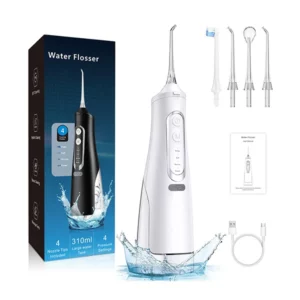
A water flosser gives the user a different route. Water passes through a narrow nozzle and can be guided from one gap to the next. Pressure changes the feel of the stream, but the nozzle, reservoir, handle, and mode controls decide how manageable that stream is in a real routine.
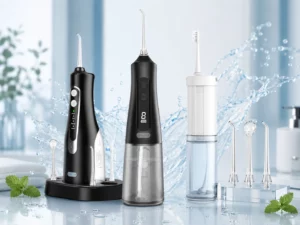
Water pressure for teeth cleaning is therefore only part of the picture. A smart model for the bathroom, a folding model for travel, and a combined brushing-and-flossing device all use water, yet they are built around different daily habits.
Where Water Pressure Helps Most
Toothbrush bristles sweep over the exposed fronts, backs, and chewing surfaces of the teeth. The space between two teeth is narrower and changes shape around a molar, wire, or bridge. Even careful brushing can leave the user with a poor angle.
String floss makes direct contact with the sides of the teeth. That can be useful in a tight gap, but it takes room to thread and steady hand movement. Braces and fixed dental work add more steps because the floss has to be guided around them.
Water reaches the area differently. A person follows the gumline with the nozzle, pauses briefly between teeth, then moves on. This can be easier to manage around back teeth and orthodontic hardware, where the usual flossing motion becomes awkward. Anyone following specific cleaning instructions after dental treatment should keep to that plan.
How a Water Flosser Shapes the Stream
Inside a cordless water flosser, a small pump draws water from the reservoir and sends it through the nozzle. The narrow opening turns that flow into a stream the user can aim at one area at a time. At the back teeth, turning the nozzle is often more helpful than forcing the handle into an uncomfortable position or immediately raising the pressure.
Water flosser PSI describes the available force, but it does not tell the whole story. The mode controls, nozzle angle, and movement around the mouth all change how the stream feels. A lower setting gives a new user time to learn the route. Once that movement feels familiar, another setting may suit a different preference.
Fine Control at Home
The M131 is a smart water flosser with nine adjustable modes, a 350 ml detachable tank, and a screen that shows the selected work mode and battery level. It is designed for users who want to see their setting rather than rely on a single default mode.
That larger tank suits a bathroom routine where stopping to refill is an inconvenience. Nine settings also give people room to settle on an intensity that feels comfortable instead of treating one pressure level as the only option.
Pressure and the Water Path
Pressure is only useful when water reaches the nozzle consistently. The reservoir, pump, internal water path, and seal around the tank all have a part in that process. A cordless device also has to work while the user changes the angle of the handle around the mouth.
For a brand project, these parts are not hidden technical details that can be left until the end. A change to the tank, body shape, pressure range, or accessory set affects the way the product is used at the sink. It belongs in the product definition before a sample is approved.
Choosing a Design for Home, Travel, or Combined Care
One water flosser does not have to meet every routine. Some people value a larger reservoir and visible control at home. Others need a device that takes up less space in a wash bag. A combined format serves a different preference again.
Foldable for Travel
The M141 portable water flosser uses a foldable body and a 210 ml tank. It has four adjustable modes, a 40-120 PSI range, double IPX7 waterproof protection, and a low-noise design. Folding the body reduces the space it takes up when packed, while the smaller tank keeps the device compact.
For travel, those are practical trade-offs rather than missing features. A smaller water supply makes the unit easier to store. The four modes still give the user a choice of settings once it is out of the bag.
A Home-Oriented Cordless Setup
The M149Pro is a home-oriented model with a charging base, four adjustable modes, a 300 ml tank, a 40-120 PSI range, double IPX7 waterproof protection, and a comfortable anti-slip grip. The configuration puts the focus on a stable daily setup rather than a folding travel body.
The tank size sits between the M131’s 350 ml home capacity and the M141’s 210 ml travel format. That comparison shows why reservoir size should be matched to the routine, not treated as an isolated number on a specification sheet.
Brushing and Water Flossing in One Device
The M41Pro combines a sonic toothbrush and a water flosser in one device. Brushing and rinsing can be selected from the same button. It has three modes, Type-C charging, a retractable water tank, and IPX7 waterproofing.
For a sink with limited storage or a travel kit with limited space, a combined device reduces the number of separate products to pack. Its retractable tank also keeps the body compact when it is stored away. It is a different product direction from a standalone home model, not a replacement for every routine.
Comparing the Main Routine
| Routine | Useful product direction | Details to compare |
| Home use with frequent setting changes | M131 | Nine modes, visible mode and battery display, 350 ml tank |
| Travel and limited storage | M141 | Foldable body, 210 ml tank, four modes |
| Regular home use in a cordless format | M149Pro | Charging base, 300 ml tank, four modes, anti-slip grip |
| Combined oral-care routine | M41Pro | 2-in-1 format, retractable tank, three modes |
The wider water flosser range gives consumers and product teams a way to start with the routine, then compare pressure controls, tank size, form factor, and the accessories that go with it.
What a Brand Needs to Set Before Development
The things a user notices in the bathroom become sample checks for a brand. A low starting mode matters when a product is aimed at first-time users. A folding body makes sense only when portability is part of the offer. A bigger tank changes the size and balance of the handle, while a different nozzle set can change the product’s intended use.
Before development begins, define the target users, pressure range, working modes, reservoir size, body format, grip, waterproof requirements, operating noise, charging method, accessories, logo, and packaging. These decisions work together. Selecting them one by one from a generic list can leave a product with no clear role in the market.
クリエイティブ has developed personal-care products since 2014, with water flossers and electric toothbrushes among its oral-care products. Its independent technical department and testing laboratory check water pressure, waterproofing, water-tank airtightness, leakage, noise, and aging. The company has more than 60 technology and design patents and more than 1,400 square metres of manufacturing space.
An OEM and ODM project can move from requirement definition through appearance and structural design, prototype work, testing, sample confirmation, and mass production. Function, colour, logo, nozzle configuration, accessories, and packaging can be tailored around the final product direction. The 品質保証プロセス adds a pre-shipment inspection step after the agreed sample has been confirmed.
結論
Water pressure helps with the parts of the mouth that are awkward for a brush head to approach. What makes a water flosser effective in day-to-day use is the way its pressure controls, nozzle, tank, body shape, and maintenance fit the routine it is meant to serve.
The M131, M141, M149Pro, and M41Pro show four different product directions: visible adjustment at home, foldable travel use, a stable cordless home setup, and combined brushing with water flossing. Each one starts from a different practical constraint.
Brands and distributors can use those constraints to brief a new project. Bring the target routine, preferred pressure controls, tank size, body format, nozzle needs, logo, packaging, and sample checks when you discuss a water flosser project.
よくある質問
Q1: What water pressure is suitable for a first-time water flosser user?
A1: Begin with a gentler setting while learning the nozzle angle and a route around the mouth. Models with several modes make it possible to change the intensity gradually once that movement feels familiar.
Q2: How important is water flosser PSI?
A2: PSI shows the pressure range available from the device. The stream also depends on the selected mode, nozzle position, and how water moves from the tank through the internal system. A number on its own does not describe the whole experience.
Q3: Which reservoir size is suitable for a cordless water flosser?
A3: A larger tank works well for a home routine where refilling is an interruption. A smaller tank helps a portable or foldable model stay compact. Choose the capacity around where the device will be used most often.