

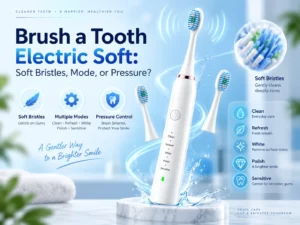
Soft electric brushing is a control problem at the gumline. Filament stiffness, motor delivery, and hand force determine how the brush behaves at the gumline. A change in one input does not cancel the other two. Soft filaments can still be compressed against the gums; a Sensitive mode can still carry a stiff brush head; a light grip can still miss the back teeth. At the sink, the phrase brush a tooth electric soft describes this combination of hardware and handling.
Search results for brush electric toothbrush, automatic brush for teeth, or how to clean teeth with electric toothbrush often treat those inputs as one feature. They are separate specifications.
What Soft Means in Electric Brushing
Soft Bristles and a Soft Mode Are Not the Same
Bristle stiffness is a physical property. A powered-toothbrush design review reported soft bristles at roughly 203–229 µm in diameter. The same review placed medium bristles near 305 µm and hard bristles near 330 µm. Filament length and material also affect deflection. Thinner filaments bend earlier and reduce the force transferred to the gumline. Thicker filaments hold their shape against the tooth surface. The ADA lists soft bristles as its recommendation for nearly the whole population. Sensitive teeth and gums are a common reason clinicians recommend a soft bristle.
The Sensitive mode changes motor delivery instead. It may reduce pulse frequency, lower vibration amplitude, or ramp the motor up gradually. It does not change filament diameter. This distinction matters because a product comparison that lists only mode names leaves out half of the softness story. The guide to choosing an electric toothbrush for sensitive teeth addresses the head-and-handle selection.
Why Gentle Pressure Matters More with an Electric Brush
The motor already supplies reciprocation or vibration; the hand controls position, angle, and contact. Adding force does not increase the number of cleaning movements. It increases bristle deflection and tissue compression. In a randomised cross-over trial, volunteers brushed at 75, 150, 225, and 300 g for 30, 60, 120, and 180 seconds. The measured plaque-removal benefit above 150 g was negligible at the 120-second endpoint. Two minutes at light contact is therefore more useful than a shorter session at heavy pressure.
Bristle shape provides the visible signal. A slight curve indicates contact; a sharp bend, splayed filaments, or a motor that slows under load indicates excessive force. The correction is mechanical rather than motivational: keep the tips in contact, loosen the grip, and allow the motor to continue its cycle. The 2014 Cochrane review reported greater plaque and gingivitis reduction with powered brushes than manual brushes in the short and long term. The same review described the clinical importance of that difference as unclear. The narrow conclusion for everyday use is that powered brushing depends on placement, not pressure.
When a Sensitive or Soft Mode Helps
A gentler mode is useful during the first week with a powered handle, when the default setting produces an uncomfortable sensation, or when a slower start helps the user learn the instrument. Some users also reduce intensity after dental work or during a period of gum sensitivity. The mode is a comfort control, not a treatment. The correct setting is the one that maintains light contact without forcing the hand to compensate. Sensitivity, bleeding, or pain that continues requires professional assessment rather than another mode change.
How to Brush with a Soft Electric Toothbrush
Start at the Gumline with the Right Angle
The bristle-tip contact point sits at the gingival margin, with the handle inclined slightly toward the crown. The tips remain on the surface rather than sliding beneath the tissue. A compact head reaches the posterior teeth with less rotation of the wrist. A fixed sequence assigns each region in turn: upper right outside, upper right inside, upper left outside, upper left inside, then the same pattern on the lower teeth, followed by the chewing surfaces.
Let the Motor Do the Work
Its motor supplies the cleaning motion, so the hand follows a slow path from tooth to tooth. Fast back-and-forth strokes reproduce manual brushing and add unnecessary force. A brief pause on each surface allows the bristles to work before the head moves on. Grip pressure matters because a tight hand tends to press the head into the gumline. Pressure feedback, when available, marks the point at which the hand should lighten its input. Without that signal, filament deflection and motor pitch provide the same information.
Cover Every Surface for About Two Minutes
The two-minute interval is a coverage standard. It allows the outer, inner, and chewing surfaces to receive attention before fatigue or habit shortens the routine. Brushing twice daily with fluoride toothpaste remains the foundation. A 30-second zone reminder divides the interval into four sections. A fixed sequence can perform the same function: upper right, upper left, lower right, lower left, then the chewing surfaces and the area behind the last teeth.
Which Features Make Gentle Brushing Easier to Repeat
Soft or Sensitive Mode
Sensitive mode changes motor delivery, which can reduce the abrupt sensation at start-up and make a powered handle easier to learn. It does not alter filament stiffness or replace a light grip. The useful feature is not the number of mode names but whether one clearly labeled setting maintains comfortable contact at the gumline.
Soft Start and Pressure Feedback
Soft start increases motor output gradually instead of beginning at full strength. Pressure feedback monitors the force transmitted through the hand. A M2 smart sonic toothbrush includes a three-second soft start and a Soft mode. M2 Art also lists a three-second soft start. Both M2 Pro and M2 Art models include a Sensitive mode and a 30-second zone reminder. These specifications belong to the named models and should not be transferred to another handle without checking its product page.
Timer, Zone Reminder, and Brush-Head Care
Timing and zone reminders control duration and coverage; neither measures contact force. Rinsing the head and allowing it to air dry protects the filament assembly between uses. Filament wear changes stiffness and tip geometry, and those properties influence how the brush interacts with hard and soft tissue. A head with splayed filaments has moved outside its intended contact condition. A new head restores the intended contact behavior more effectively than additional hand pressure.
What to Check Before Choosing a Soft Electric Toothbrush
A self-cleaning electric toothbrush is evaluated by whether it keeps gentle coverage repeatable. Four specifications narrow the decision: soft bristles and an appropriately sized head; an easily selected Soft or Sensitive mode; pressure feedback for users who tend to apply force; and a two-minute timer, zone reminder, and clear replacement guidance. Handle diameter and surface texture affect grip strength, particularly for children or users with limited hand strength.
Mode names are not standardized. One Sensitive setting may lower vibration amplitude, another may reduce pulse frequency, and a third may delay full output at start-up. The label alone does not reveal which change occurs, so the useful comparison is between the motor behavior, the contact pressure, and the brush-head specification.
Timers and pressure sensors create different feedback loops. A timer enforces duration; a zone reminder enforces coverage; a pressure sensor or feedback signal addresses force. Only the last item responds directly to the 150 g force threshold described in the brushing-force trial. The handle can therefore have excellent timing while still allowing excessive force.
Bristle condition belongs inside the same control loop. During use, filaments bend repeatedly and may retain a splayed shape. That change alters stiffness and tip geometry, so the same hand pressure can produce a different contact condition from the one the head delivered when new. Replacement restores the intended filament geometry more reliably than a change in technique alone.
Handle geometry also changes the force path. A narrow or slippery handle requires a stronger grip, and extra grip force can translate into more axial pressure at the brush head. A handle that fits the user’s hand allows a lighter hold, which supports the low-force target without changing the motor or the brush head.
The soft routine should be evaluated across the full cycle: start-up, steady-state brushing, movement between quadrants, and the final surfaces behind the last teeth. A handle that feels gentle at start-up but requires extra force later in the cycle does not deliver a consistent soft routine, even if its display shows a Soft or Sensitive label.
Model-level comparison matters because “soft” is not a shared specification.
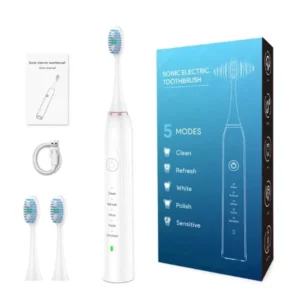
M1/M3 sonic electric toothbrushes list a vibration range of 31,000–43,000 times per minute and five modes: Clean, Refresh, White, Polish, and Sensitive. The model pairs a 30-second mode-change reminder with automatic shutdown after two minutes and lists IPX7 waterproofing, a 2-hour charging time, a 1,200mAh battery, Type-C charging, and DuPont brush-head material. M2 lists a three-second soft start and five modes: Clean, Soft, White, Polish, and DIY, together with a 30-second smart zone reminder, low-battery indicator, 360° brush head, TFT screen, anti-vibration silicone neck, IPX7 protection, a 1,200mAh battery, Type-C charging, and a two-year warranty. M2 Pro and M2 Art list a Sensitive mode among five modes, a 30-second smart zone reminder, low-battery indicator, 360° brush head, anti-vibration silicone neck, IPX7 protection, a 1,200mAh battery, Type-C charging, and a two-year warranty; the M2 Art also lists a three-second soft start and TFT display. Product teams can compare these details on the M3 smart electric toothbrush page and other model pages.
How Mlikang Approaches Gentle Electric Toothbrush Design
Mlikang has more than ten years of experience in personal oral-care devices, with a portfolio that includes electric toothbrushes and water flossers. The company develops and manufactures water flossers and electric toothbrushes. Its product portfolio also includes beauty devices and other personal care products.
The model differences explain why the design brief must be precise. M1/M3 sonic electric toothbrushes offer Clean, Refresh, White, Polish, and Sensitive modes, along with a 30-second mode-change reminder and automatic shutdown after two minutes. Model M2 includes a three-second soft start and a Soft mode, with Clean, Soft, White, Polish, and DIY modes. M2 Pro and M2 Art models include a Sensitive mode and a 30-second smart zone reminder. Those settings are model-specific and should not be assumed for every electric toothbrush. Mlikang supports OEM/ODM customization for oral-care categories including water flossers and electric toothbrushes, and provides development and customization for products such as electric toothbrushes.
A gentler brushing proposition therefore has to connect filament stiffness, motor delivery, pressure feedback, timing, handle geometry, and replacement-head behavior across the full two-minute cycle. Otherwise the product may carry a soft mode name without delivering a coherent soft routine.
Bristle stiffness is set by the brush head. Motor delivery is set by the handle. Hand force is set by the user. A replacement head resets the first variable but not the second or third. A mode change resets the second but not the first or third. A grip adjustment resets the third. The variables can be checked independently. Some handles can have a pressure sensor without a zone reminder. Other handles can have a zone reminder without a pressure sensor. Some handles can have both feedback systems and a standard motor setting. The useful comparison is therefore specification-by-specification. Timer behaviour, motor behaviour, bristle condition, and hand force each describe a separate part of the same routine. None substitutes for the others.
The cleaning cycle has four checkpoints: placement, contact, coverage, and time. Placement sets the angle. Contact sets the force. Coverage sets the sequence. Time sets the duration. A timer can confirm duration but not placement. A pressure signal can confirm force but not coverage. A zone reminder can confirm sequence but not bristle condition. The four checks remain separate even when one handle provides all three electronic reminders.
Conclusion
Soft electric brushing is not a single button or brush-head label. It is a combination of soft bristles, a comfortable lower setting when required, and a hand that allows the motor to perform the cleaning motion. The routine works when the head meets the gumline, the user moves slowly, all surfaces receive about two minutes, and pressure feedback or a timer supports consistency. Brands developing a product around this reader need can work with Mlikang to turn those decisions into a model-specific OEM/ODM brief.
FAQs
Q1: Does a soft mode mean the bristles are soft?
A1: No. A Sensitive mode changes the motor’s movement, while soft bristles describe the brush-head material. Some products have one, both, or neither; check both specifications.
Q2: Can I brush too hard with an electric toothbrush?
A2: Yes. Its motor provides the cleaning movement, but the hand still controls contact pressure. Keep the bristles in light contact and use pressure feedback when available.
Q3: How long should I brush with a soft electric toothbrush?
A3: Spend about two minutes twice a day and cover all outer, inner, and chewing surfaces. A lower setting does not shorten the routine.