

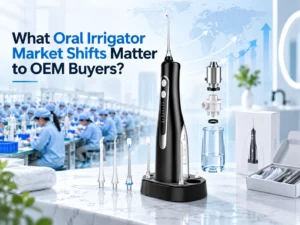
The oral irrigator market is moving away from a simple choice between a countertop appliance and a basic portable unit. Buyers now encounter cordless formats, multiple pressure modes, professional-use language, connected features, and packaging expectations in the same product conversation. For an OEM buyer, a market shift matters only when it changes the product brief, the channel plan, or the evidence required before mass production.
That distinction is easy to lose when market reports focus on growth rates and category size. A brand does not need every new feature on the market. It needs to know which changes alter the product it is asking a supplier to develop, which ones affect the launch package, and which claims still need model-specific proof.
Market shifts that change the brief

The most useful way to read oral irrigator market trends is to separate demand signals from feature lists. A signal changes the brief because it affects how the product will be used, sold, or supported. A feature is only a possible response. Cordless demand, professional-care language, and channel-specific expectations all qualify as signals because they change the questions a brand should settle before tooling and production.
Geography and channel are making the oral irrigator industry less uniform. A product designed for a large home bathroom may not fit the same brief as one intended for travel, a subscription bundle, or a professional recommendation. Buyers do not need to treat every regional preference as a universal rule, but they should record which market and channel assumptions the product is being built to serve.
Cordless and portable use as a default product assumption
Portability is no longer a niche variation. It changes the size of the water tank, the charging architecture, the placement of controls, and the way a user judges whether the device is easy to refill and clean. A brief that starts with a countertop form and removes features later often creates avoidable compromises. Stating the intended use pattern first is more efficient, then deciding which countertop or cordless characteristics follow from it.
That shift also affects how a water flosser manufacturer is evaluated. A supplier may be able to produce a cordless-looking unit, but the buyer still needs evidence that the selected design can support the intended runtime, sealing, pressure range, and cleaning routine. Model boundaries matter. A specification that is valid for one water flosser should not be copied into another project without checking the approved design and test plan.
Professional and post-treatment signals moving into home use
Professional and post-treatment settings are influencing home-device expectations. Orthodontic care, implant maintenance, and recovery routines create demand for gentler control, clear mode selection, and instructions that help users avoid treating every situation as a high-pressure cleaning task. Those signals are application context, not proof that a home device reproduces a clinical procedure.
For product planning, the practical question is whether the article, label, and onboarding material explain the intended use without overpromising. A visible mode or a pressure-control range can support a better routine when the design and instructions are aligned. The same features become a risk when marketing language suggests a clinical outcome the product evidence does not establish.
Decisions the market shifts should change
Once the signals are clear, they should change four parts of the brief: the product experience, the packaging and brand scope, the evidence requirements, and the production plan. A fast launch can be attractive in the oral irrigator market, but speed is not a substitute for defining what the buyer is actually approving.
A useful brief turns broad language into decisions. “Portable” becomes a target use case and a set of dimensional constraints. “Gentle” becomes a pressure range, mode behavior, and user instruction. “Premium” becomes a packaging structure, artwork standard, and proof requirement. Each decision should have an owner and an acceptance condition before the project moves into tooling or bulk production.
Pressure, modes, and user feedback in the product experience
Pressure control and mode design are not interchangeable. A mode label tells the user what the product intends to do; pressure behavior determines what the stream actually does. The brief should specify the pressure range, how modes differ, what the user sees or feels when the setting changes, and how the device behaves when the tank is low or the nozzle is partly blocked.
User feedback deserves the same treatment. A display, vibration, light, or audible cue can reduce uncertainty, but only if it corresponds to a real operating condition. A product team should decide which feedback is essential, which is optional, and which could create a support problem if it is unclear. That is a more useful design discussion than adding features to match a competitor’s specification sheet.
A water flosser OEM strategy should also account for the relationship between feature density and validation work. More modes, sensors, or connected functions can expand the number of conditions that must be tested. The right strategy is not to minimize features at any cost; it is to connect each promised experience to a design decision and a verification step.
Model-level specifications show why that discipline matters. The M209 water flosser has a low-noise design of less than 60db, four adjustable flushing modes, double IPX7 waterproof protection, a pure copper motor, a comfortable grip, and an anti-slip design. Its rated voltage is 3.7V, battery capacity is 2000mah, water tank is 310ml, and water pressure is 40–120PSI.
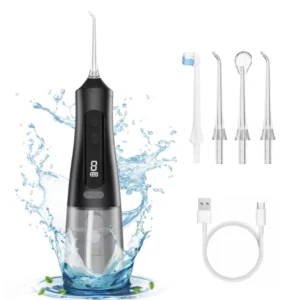
The M131 water flosser adds a smart LED screen display that makes battery level and work mode visible. It also has double IPX7 waterproof protection, 1–9 adjustable flushing modes, a pure copper motor, low-noise design of less than 60db, a 350ml large capacity water tank, rated voltage of 3.7V, battery capacity of 2000mah, and water pressure of 30–120PSI.
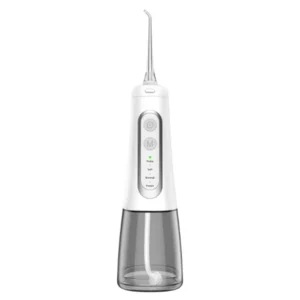
M139Pro water flosser uses a smart LED screen display, battery level and work mode visibility, double IPX7 waterproof protection, four modes, a pure copper motor, low-noise design of less than 60db, a 300ml large capacity water tank, rated voltage of 3.7V, and water pressure of 30–130PSI. Those differences matter because a mode label alone does not define the pressure range, runtime, tank capacity, or waterproof treatment that the buyer is approving.
Packaging and logo scope in the launch decision
Packaging and logo scope are often treated as late-stage artwork tasks, yet they can change the product brief much earlier. A retail package must hold the device, accessories, instructions, and any required labels without creating damage or an unstable unboxing experience. An e-commerce pack may need different protection, dimensions, and graphics from a shelf-ready pack.
The approved Mlikang development path covers appearance and structural work, function definition, prototype approval, branding, and packaging within a supported project scope. Buyers can use the Water Flosser Custom Development Case (OEM/ODM) to see how one project moved from concept and appearance decisions toward prototype and production. The example is a reference point for the process, not a promise that every project follows the same schedule or specification.
That custom-development case began with a product development specification covering target markets, portable positioning, private-label customization, stable pressure, low noise, and easy cleaning. Appearance work included ergonomic grip, compact body, color and finish options, and logo treatments such as silk screen or laser engraving. Structural work covered the motor, pump, battery, water tank, circuit board, gravity ball water absorption, spring buffer vibration control, independent IPX7 waterproof structure, molding feasibility, assembly, and cost control. Function definition then set the cleaning modes, pressure range, rechargeable battery, waterproof requirement, rotatable nozzle, and certification requirements. Such items are examples of the decisions that belong in a packaging and launch brief before artwork is frozen.
Before a water flosser manufacturer receives final artwork, the brand should define logo placement, color references, language and market requirements, packaging structure, and the approval sequence. This prevents a late packaging change from forcing a product change after the design has already been validated.
Using market evidence without overclaiming
Several public estimates cover the oral irrigator market, but they do not agree on the size or growth rate. One widely circulated view projects steady growth from a market measured in billions of dollars. Another uses a different base year, product definition, and growth rate. The disagreement is not a reason to ignore the oral irrigator industry. That disagreement is a reason to treat market numbers as assumptions that must be tested against the brand’s channel, target price, and product scope.
Buyers should also separate market evidence from product evidence. A market report may show that a feature category is growing. It does not prove that a specific pump, battery, seal, pressure setting, or connected function will perform as intended. The brief needs its own acceptance criteria and model-specific evidence before those claims reach a product page or sales deck.
Why market forecasts differ and how to test assumptions
Forecasts differ because researchers define the category and base year differently, count different product types, and may include different distribution channels. A buyer should not choose the highest number and present it as the market’s guaranteed outcome. A more defensible approach is to build low, base, and high scenarios that correspond to different channel assumptions, price points, and launch volumes.
Each scenario should identify what would change the plan. If online demand grows faster than expected, does the package need to be optimized for shipping and returns? If professional recommendations become more important, does the product need clearer mode instructions or a different support path? If the category slows, which features or SKUs can be delayed without undermining the core product?
This is where a water flosser OEM strategy becomes a planning discipline rather than a slogan. The supplier conversation should focus on which design decisions are fixed, which are optional, and which require additional samples or testing. A flexible plan is more useful than a forecast treated as certainty.
Where clinical context ends and product claims begin
Clinical evidence can explain why oral irrigation is used alongside other oral-care methods and why some users need gentler control. It cannot automatically transfer to a specific product. A study may describe a device category, a participant group, or a supervised routine that differs from the product being developed.
The safe boundary is to use clinical context to inform use cases and instructions, then verify the product’s own performance against its approved design. Statements about pressure, sealing, battery behavior, cleaning modes, or waterproofing should remain tied to the model and evidence that support them. This keeps the article and the eventual product page credible without turning general research into a company guarantee.
Validation before mass production
Validation is where the brief stops being a document and becomes an approved product. The buyer should know what will be checked, which unit or batch the result covers, what acceptance criteria apply, and what happens when a result falls outside the approved range. A sample that looks correct is useful; a sample supported by a traceable approval decision is more useful.
The validation plan should match the risk of the project. A new housing, pump, seal, charging system, or control interface can create different risks than a color change on an existing platform. The buyer does not need the same test plan for every project, but the reasoning for the selected scope should be explicit.
What the sample and approval sequence should prove
A prototype should prove more than appearance. It should show that the selected functions work together under the intended use conditions and that the user can operate the device without ambiguous instructions. The approval sequence should record the approved sample, revision, key specifications, and any deviations that the buyer has accepted.
The documented development flow moves from idea and demand confirmation to appearance design, structural design, function definition, and a handboard or prototype. The prototype checks appearance, size, assembly, grip, structure, water pressure, waterproofing, noise, and battery behavior. Client confirmation before mold opening and an approved prototype plus test report create a clearer reference than a sales sample alone. The exact checks still depend on the approved design, but the sequence shows why sampling should be tied to a defined decision rather than treated as a formality.
Structural design can begin with the internal structure layout for the motor, pump, battery, water tank, and circuit board. Core structural innovations can include a gravity ball structure for complete water absorption, a spring buffer structure to reduce noise and vibration, and an independent waterproof structure for IPX7 protection. The stage can also cover molding feasibility analysis, assembly optimization, and cost control, with outputs such as a 3D structural model, BOM, and assembly drawing. Those points are concrete reasons for the buyer to approve the structure before mold opening rather than discovering a fit or sealing issue later.
Function definition should produce a function test standard and verification plan. A typical water flosser project may use three to five cleaning modes, such as normal, soft, pulse, strong, or custom; a 30–120 PSI adjustable water pressure range; a 1400–2000 mAh battery with USB recharging and two to four weeks of usage; full-body IPX7 washability; and a 360° rotatable, detachable nozzle. Certification-compliant requirements may include FDA, CE, RoHS, and FCC, while the final applicable list still depends on the target market and the approved model.
For a replacement or modified model, the buyer should confirm how the new version differs from the existing platform. The How to Choose the Right Water Flosser OEM/ODM Manufacturer page can help frame the supplier-evaluation questions, while the approved sample remains the project-specific reference. A general supplier checklist does not replace a model-level approval record.
Mlikang supports sampling and mass-production coordination within an OEM/ODM project. The exact sample plan, revisions, and acceptance criteria still depend on the product, market, and current project terms.
Evidence needed for production release
Before mass production, the buyer should confirm the final inspection scope, the records that connect results to the batch, and the disposition of any nonconforming units. For a water flosser, relevant checks may include sealing, leakage, pressure behavior, charging, noise, and the model-specific water-protection requirement. The applicable checks depend on the approved design, so the brief should identify the requirement each test is meant to verify.
The From Concept to Mass Production guide provides adjacent context for moving from development into production. A working file should still capture the model and revision, lot or unit identifiers, inspection date, method, result, deviation, corrective action, and release decision.
Mlikang describes inspection before shipment and model-specific testing resources. Those statements support the need to verify the production plan; they do not turn equipment availability into a universal performance guarantee. The release decision belongs to the approved model, customer requirements, and the current batch record.
A practical release file can connect the approved sample and revision to incoming components, critical assembly steps, finished-unit checks, and the disposition of nonconforming units. Every product can undergo 100% inspection before shipment, with batch inspections covering quality standards and customer requirements. A strict quality control process aims to minimize defects and support consistent performance; product identification, inspection results, and corrective-action records help the buyer and supplier discuss the same unit or lot. For custom projects, the file should also preserve the agreed function test standard and verification plan so that a late design change does not leave the production record without an approved baseline.
The production discussion can also cover OEM, ODM, and OBM scope, appearance design, functional customization, customized product development, branding, and packaging. An experienced engineering team can support the path from concept to mass production, with flexible MOQ, fast sampling, and mass-production planning. A one-to-one professional after-sales team, up to two years of after-sales service, and rapid shipment for small orders may also matter when the brand is testing a new market or preparing for a seasonal launch. Small orders shipped within 24 hours can reduce inventory pressure and help a brand test a new market quickly.
Small orders can ship within 24 hours to support fast-moving markets and urgent orders. That capability helps customers reduce inventory pressure, test new markets quickly, and respond rapidly to sales opportunities. It is useful when a brand needs market feedback before committing to a larger production plan.
One-to-one professional after-sales support assigns each customer a dedicated team. This structure supports fast communication, accurate problem handling, and technical assistance throughout the cooperation. Up to two years of after-sales service can help partners reduce after-sales risks, protect brand reputation, and maintain smooth market operations.
Every product undergoes 100% inspection before shipment to support compliance with quality standards and customer requirements. The quality-control process is intended to minimize defects, maintain consistent performance, and support reliable products delivered to each customer.
Conclusion
Only shifts that change a decision the buyer can define and verify should influence the oral irrigator market plan. Portability changes the form and use case. Professional signals change instructions and mode expectations. Packaging changes the launch scope. Conflicting forecasts change the assumptions that need testing. Clinical context changes the questions asked, not the company claims made. The practical next step is to turn those signals into an approved brief with named functions, packaging scope, sample criteria, and production evidence. Buyers who do that can compare suppliers on a consistent basis instead of reacting to the newest feature claim. Mlikang can support the next project discussion through its documented OEM/ODM development, customization, sampling, MOQ, inspection, and production scope, with final requirements tied to the selected model. Start by defining the target market and product brief, then request the Water Flosser Custom Development Case (OEM/ODM) as a reference for the next planning conversation.
FAQs
Q1:Which market shift should change a product brief first?
A1:Start with the use case and channel that determine the product’s physical form and daily operation. If the target buyer needs portability, that assumption should be settled before pressure modes, packaging size, or optional connectivity are finalized. Oral irrigator market trends become useful only when they change such a decision.
Q2:Should packaging and logo come before or after the product specification?
A2:Set the product specification first, then lock packaging and logo scope against that approved design. Packaging can still influence size, accessory layout, and protection requirements early in the brief, but artwork should not be approved before the product structure and market requirements are stable.
Q3:What evidence should a brand request before mass production?
A3:Ask for the approved sample and revision, acceptance criteria, applicable test results, final inspection scope, lot or batch traceability, and the release disposition. A water flosser manufacturer should be able to connect each result to the exact model and production record rather than offer a general statement about quality. For supplier-evaluation context, review the How to Choose the Right Water Flosser OEM/ODM Manufacturer? page, then apply the project-specific criteria in the approved brief.