

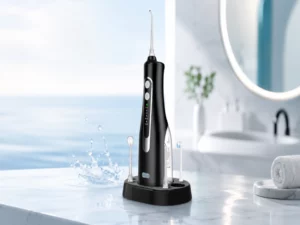
Traditional floss has one clear strength: the strand touches the tooth surface directly. A water flosser cleans with a controlled stream instead. Water often becomes the more practical option when braces, bridges, back teeth, or limited hand movement make string floss difficult to use.
The difference is not only mechanical. A routine that takes too long, feels awkward, or is repeatedly skipped does not deliver its intended benefit. The more useful question is whether the method can be performed correctly and consistently, not only how it cleans.
Once water is the more workable method, the device can still create new friction. Poor pressure control, a tank that forces a refill, the wrong nozzle, a slippery grip, or difficult cleaning all make the routine harder to repeat. A useful device has to remove those barriers before its specifications mean much.
How Water Flossers and Traditional Floss Clean Differently
String floss and water do not perform the same motion. The strand presses against the side of the tooth; water travels through the gap and along the gumline. That mechanical split defines water flosser vs dental floss.
Traditional string floss is guided between two teeth and curved around the side of each tooth. Moving the strand gently against the tooth surface provides direct contact that can lift sticky buildup from tight spaces. A water flosser works differently, using a stream of water rather than the same rubbing motion.
Traditional floss is also inexpensive, easy to carry, and ready without a tank or charging space. For a user who is already comfortable with the technique, it remains a simple routine. Its practical limits appear when the back teeth are difficult to reach or dental hardware turns the strand into a threading task.
Water leaves the device in a narrow stream and moves between teeth and around the gumline. It helps loosen food and rinse around brackets, bridges, and other dental work. The stream reaches these areas without requiring floss to be threaded through every opening.
ADA interdental guidance recognizes several forms of interdental cleaning and does not treat one method as the best answer for everyone. Some routines use one method; others use both.
Bleeding, pain, recent dental treatment, or another specific oral condition changes the decision. A dentist should be consulted before switching methods in those situations.
When a Water Flosser Becomes the More Practical Choice
Around Braces, Bridges, and Back Teeth
Braces and bridges create small spaces that string floss has to pass through before reaching the tooth surface. Near the back teeth, seeing and guiding the strand becomes harder. A water stream can move around brackets and bridgework without being threaded through each opening. Easier access is the main practical advantage for these users, and the routine is easier to repeat. The same reasoning applies when dental work turns a short daily task into a sequence that takes too much time.
When Handling String Floss Becomes the Barrier
Limited hand movement makes a thin strand difficult to control, especially behind the last molars. Repeatedly skipping floss because the process feels slow or awkward is another sign that the method is not fitting the routine. At that point, water flosser vs floss is less about a theoretical winner and more about execution: whether the cleaning can be completed comfortably and repeated the next day. When water removes the handling barrier, it is reasonable to start evaluating a device. Pressure, tank capacity, nozzle access, grip, and maintenance then become the test of whether water flossing will actually be easier.
What Makes a Water Flosser Easy to Use Every Day
Pressure Control and an Uninterrupted Session
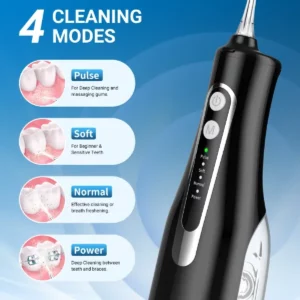
After water becomes the practical fit in water flosser vs regular floss, pressure is the first setting the user meets. A beginner often needs a gentler stream, while an experienced user may prefer more intensity; one fixed level can be uncomfortable at one end and too mild at the other. The M149Pro water flosser offers four modes across 40 to 120 PSI, giving users room to begin gently and settle on a comfortable setting. The highest number is not automatically the best one.
Tank capacity matters a few moments later. Stopping to refill adds another step to a routine that may already feel demanding. The M149Pro’s 300 ml tank reduces the chance of an interruption during normal home use. More water supports a continuous session; it does not make the cleaning action stronger.
Nozzles, Grip, and Cleaning After Use
The nozzle decides where the stream can be directed. Four replaceable nozzles allow the M149Pro to address the back teeth and areas around dental appliances. The tip still needs rinsing after use and should not be shared.
Wet hands test the handle. A comfortable, non-slip grip lets the M149Pro be guided without a tight squeeze, while its IPX7 waterproof design suits bathroom use and routine rinsing. The tank and tips still need cleaning, and the device should be dried as instructed before it is put away.
For readers leaning toward water in water flosser vs dental floss, these details become the product checklist. They can review the M149Pro against the barriers above, then compare the wider water flosser range if a different configuration fits better. The point is not to chase the longest specification list. It is to find a device that makes the intended routine easier to complete.
What Brands and Distributors Should Verify Before Ordering
Turning User Needs Into Sample Checks
Pressure, tank size, nozzles, grip, waterproofing, and noise begin as user concerns. For a brand, distributor, or sourcing team, they become sample-review items. Pressure has to suit the target market; the tank has to support the intended session without upsetting body balance; the remaining details affect how the sample feels, sounds, and behaves in use.
These requirements are connected. A larger tank changes the body size and balance, while a different pressure range may require changes to the pump, modes, or nozzle. Mlikang’s independent technical department and testing laboratory can review those links from requirement definition and structural design through prototype evaluation.
During quality assurance checks, Mlikang reviews water pressure, waterproofing, noise, tank airtightness, leakage, and aging. These tests cover details users notice: stream consistency, operating sound, whether the tank seals, and how the device behaves in a wet bathroom. The same list gives buyers defined points to examine during sample review.
From Prototype Review to Pre-Shipment Inspection
Prototype review gives the buyer a physical unit to hold, operate, and assess before production decisions are fixed. Through OEM/ODM customization, function and appearance can be aligned with the target market, followed by color, logo, nozzle configuration, and packaging. A family-focused retail product may need a different tip set or presentation from a compact online offer, so a generic configuration is not enough for every channel.
Sample approval should record the agreed appearance, size, assembly, grip, water pressure, waterproof performance, and noise. Pre-shipment inspection adds another checkpoint after production. Neither step replaces clear specifications or buyer approval, but together they reduce gaps between the first requirement, the approved sample, and the product prepared for sale. This gives sourcing teams a reason to arrive with user needs and sample checks already defined.

Conclusion
Traditional floss keeps its direct-contact advantage. For water flosser vs traditional floss, however, better often means easier to perform correctly and consistently. Around braces, bridges, back teeth, or limited hand movement, water is frequently the more practical route. It is not a complete replacement for every user, and bleeding, pain, or recent treatment still calls for a dentist.
A water flosser earns its place only when it removes the barriers that make string floss difficult. Adjustable pressure, a 300 ml tank, suitable nozzles, a secure grip, IPX7 protection, and straightforward cleaning matter more than chasing the highest pressure figure. Consumers can review the M149Pro and the wider range against those specific needs.
For brands, distributors, and sourcing teams, the same logic becomes a development brief. Start with the target market and preferred pressure modes, then confirm tank size and nozzle needs. Logo and packaging follow the product configuration, while sample checks define what must be approved before production. Teams with those details ready can discuss product requirements with Mlikang and move from a generic water flosser to a configuration built around the intended user.
Frequently Asked Questions
Q1: Can a water flosser completely replace traditional floss?
A1: Not for everyone. String floss supplies direct contact in water flosser vs string floss, while water rinses areas that may be harder to reach. Tooth spacing, dental work, technique, and advice from a dental professional still matter. Some users rely on one method; others keep both.
Q2: Who may find a water flosser easier to use?
A2: Water flossing is often more practical around braces, bridges, and back teeth, or when limited hand movement makes a strand difficult to control. It can also help when string floss is repeatedly skipped because threading and reaching take too long. Bleeding, pain, or recent treatment should still be discussed with a dentist.
Q3: What features matter in a water flosser for daily use?
A3: Adjustable pressure and enough tank capacity for a normal session are the first features to check. Suitable nozzles help direct the stream, while a secure wet-hand grip, waterproof construction, and simple rinsing and drying support daily use. Mlikang’s M149Pro brings these points together with four modes from 40 to 120 PSI, a 300 ml tank, four replaceable nozzles, a non-slip grip, and an IPX7 waterproof design.